🎁 Save 100 Lei. ❤️ You choose the cause. We donate.Create a plan

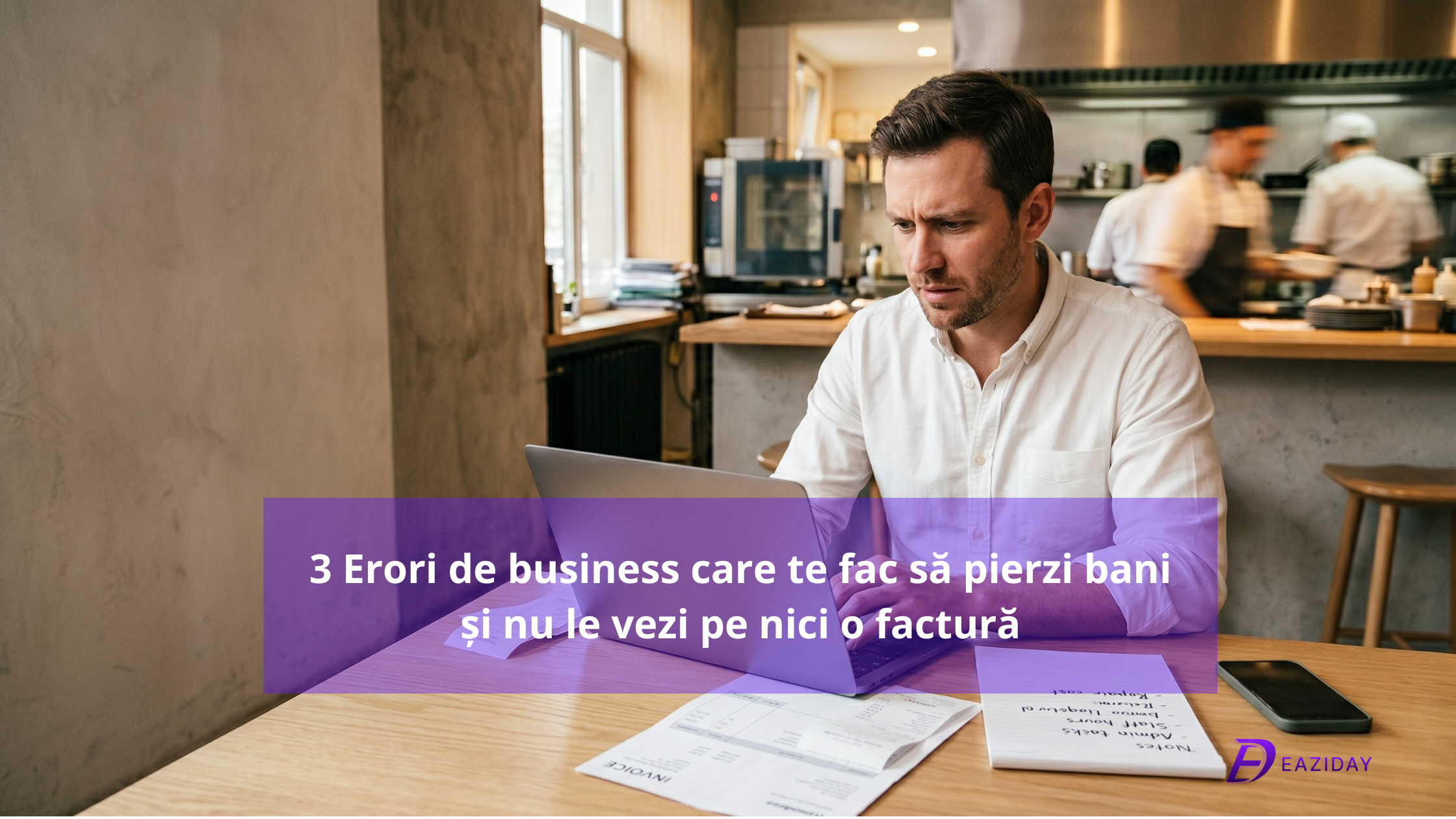
3 Business mistakes that cost you money and never show up on an invoice
5 months ago
• ⏱️ 5 min read
Discover the 3 hidden business mistakes that cost you money daily through chaotic procurement. Learn how to stop operational losses and automate with Eaziday!
Last week, someone on your team went to the store to buy toilet paper or dish soap. Maybe you sent them. Maybe they went on their own initiative. Maybe they paid out of pocket and left the receipt on your desk to be reimbursed.
Do you know what's fascinating? That quick trip cost the company more than the products themselves. Probably 3 to 4 times more. And you will never find a line in your accounting software that says: "Loss from chaotic procurement - May."
When we think about business mistakes that cost you money, we usually think of major management missteps or failed marketing campaigns. However, hidden operational costs are real, recurring, and silently eating away at your profit margins.
Here are the 3 major procurement mistakes most companies make daily and how you can stop them.
Error #1: Sending Employees to the Store for Consumables
Let’s do some simple math. If an employee costs your company an average of $15 to $20 (75 - 100 RON) per hour (including taxes and benefits), a quick run to the supermarket is rarely "quick."
A trip to the store for office supplies involves: getting ready, driving back and forth, wandering the aisles, waiting in line at the checkout, unpacking, and handing over the receipt. Realistically, we are looking at a minimum of 60 to 70 minutes.
The Math of Invisible Losses:
Labor cost for the trip: ~€15–€20 (75 - 100 RON)
Value of the purchased product: ~€5 (25 RON)
The REAL cost of the purchase: ~€20–€25 for a €5 item. (100 - 125 RON)
And that’s the optimistic scenario. In reality, 8 out of 10 people buy at least one extra item when they enter a supermarket because stores are designed to encourage impulse buys.
If you have an office of 30 people and do three of these trips a month, you lose the equivalent of a few full working days of an employee every year. Exclusively on chasing down detergent. It won't bankrupt you, but it’s a monthly tax you are paying for absolutely no reason.
Error #2: Having More Suppliers Than You Realize
Ask any manager how many active suppliers they have for hygiene and cleaning products. The typical answer? "A few. I’m not exactly sure."
A real audit usually reveals between 6 and 12 different sources: one for detergents, another for paper towels, an online store found during an emergency, and the corner supermarket.
What is the real problem? Processing costs.
Every supplier means a separate invoice. Every invoice must be received, checked, entered into the software, approved, paid, and reconciled. The average global cost of manually processing a single invoice is around €12–€15 (60 - 75 RON) , simply because it involves human time at every step.
If you have 8 suppliers sending one invoice a month, you are processing 96 invoices a year just for cleaning supplies.
Hidden administrative cost: roughly €1,200+ (6000 RON+) annually.
Furthermore, when your expenses are fragmented, you lose control. You can't negotiate bulk pricing, you don't notice when a supplier raises their prices by 8%, and you can't do accurate financial forecasting. At the end of the year, your accountant wastes hours manually piecing together expenses from multiple sources.
Error #3: Reactive Restocking (Running Out at the worst possible time)
This is the error managers feel the most, yet they often blame it on bad luck. It’s not bad luck; it’s a predictable pattern.
When you only order consumables after noticing they are gone, you guarantee that your stock will hit zero exactly when you need it the most:
- Friday night, the restaurant is packed, and you run out of table sanitizer.
- Monday morning, in the medical clinic, the soap dispenser goes empty.
- Wednesday at noon, in the office building, there is no more toilet paper.
The financial consequences of emergencies:
When you have to urgently fix a problem, you run to the nearest retail store. There, you pay retail prices, 25 - 40% more than you would have paid from a planned, wholesale order. For a restaurant or an office with 30–50 employees, these emergency purchases generate an extra cost of hundreds or even thousands of dollars a year.
How to Stop the Losses? Put it on Autopilot with Eaziday.
All these business errors share a common root: procurement is managed reactively, fragmentally, and without a clear system. Not because managers aren't capable, but because this product category seems "too small" to deserve a dedicated process. That is exactly why it spirals out of control.
The solution isn't to work harder; it’s to implement an automated supply plan:
- One single supplier for everything: Professional detergent, soap, sanitizer, toilet paper - all from one place.
- Automated recurring deliveries: Set the intervals (weekly, bi-weekly, monthly) based on your consumption. No more sending orders, no more checking inventory.
- One monthly invoice: Accounting processes 1 document, not 12.
- Total cost control: Access a clear dashboard where you see exactly how much you spend per location and product type.
This is what Eaziday does for smart businesses. It’s not just a cleaning supply solution; it’s a cost-optimization system that frees up your time.
If you recognized at least one of these errors in your company, it’s worth taking 30 minutes today to set up a plan. Not just for the money saved, but because you permanently eliminate a recurring headache from your business.
Configure your business plan with Eaziday today and stop the invisible losses!