🎁 Save 100 Lei. ❤️ You choose the cause. We donate.Create a plan

The invisible weight of your home: How to permanently eliminate the Cleaning Mental Load
Table of Contents
What exactly is the "mental load" of household management?
Why do cleaning supplies generate so much domestic stress?
The cabinet under your sink: A snapshot of anxiety
Mental load and relationships: The real reason couples fight
The psychology of space: The clean house paradox
Eaziday: Life on Autopilot
5 months ago
• ⏱️ 6 min read
Exhausted by household management? Discover how the "mental load" drains your energy and how to permanently eliminate it by automating your cleaning supplies.
You’re on vacation. You’re lounging on a beach chair with a cold drink right next to you. The sun is perfect, you have nothing urgent to do, no meetings to attend, and no one needs anything from you.
And yet, out of nowhere, it hits you: "When I get home, I’m going to have a mountain of laundry to do... and I'm pretty sure we’re out of detergent."
Where did that thought come from? It popped up like an unclosable notification right in the middle of a perfectly peaceful moment.
This is the mental load. It’s not clinical anxiety, and it’s not just passing stress. It is the reality that a portion of your brain is permanently running a background inventory of your household: what’s running out, what needs to be bought, what you forgot last time. And it does this regardless of what you’re actually focusing on in the foreground.
What exactly is the "mental load" of household management?
For a long time, people thought this was strictly a personal failing. They believed they just weren't organized enough or were too obsessed with keeping a tidy house. The reality is quite different.
In 2019, Harvard researcher Allison Daminger published a study demonstrating a crucial fact: the mental management of a household is real work. This invisible labor consists of four distinct phases, each consuming cognitive energy:
- Anticipation: Realizing that a product will be needed soon.
- Identification: Deciding exactly what solution or brand is required.
- Decision: Figuring out where, when, and how to buy it.
- Monitoring: Checking if the item was actually purchased and put in its proper place.
The problem? This work isn’t on anyone’s job description. You can't see the results at the end of the day. And, unfortunately, it is rarely distributed equally. A recent European study shows that 71% of women and 43% of men admit that the mental management of their household directly affects their sleep quality.
Why do cleaning supplies generate so much domestic stress?
There are expenses you set and forget. You pay your car insurance once a year. Your electricity bill is on auto-pay.
Cleaning supplies don't work like that. They have an exhausting, unpredictable dynamic:
Dish soap runs out every 2 weeks.
Hand soap magically disappears right when you host guests.
Toilet paper requires constant restocking.
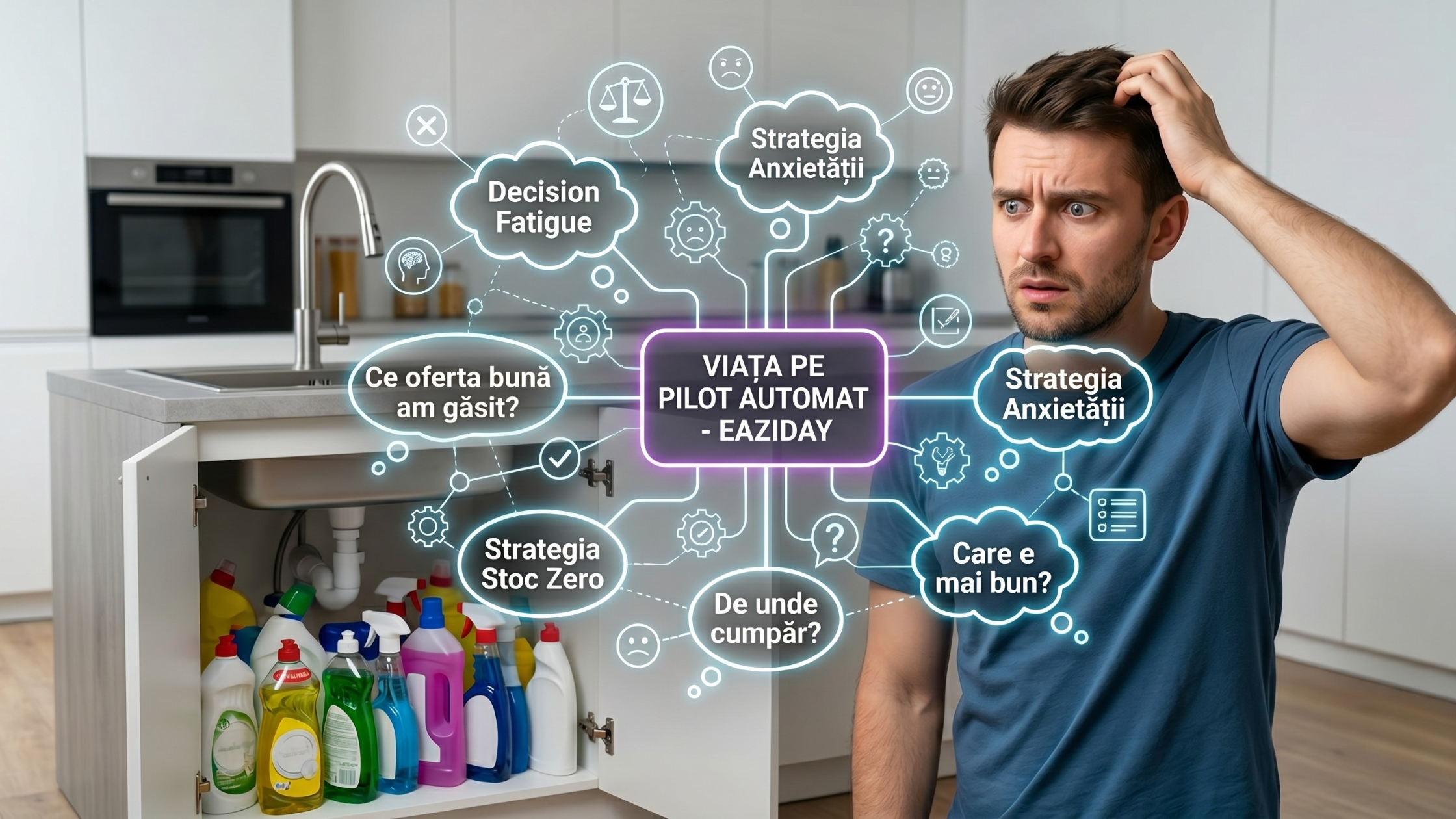
Every single product regenerates and returns to your mental to-do list endlessly. Psychologists call this phenomenon "decision fatigue." Your brain has a limited reserve of good decisions it can make in a single day. Every micro-decision you make about the price of laundry detergent or the brand of glass cleaner drains the exact same energy pool you rely on for your career, your family, or your health.
💡 Did you know? For just one category of products (cleaning and hygiene), your brain runs through 180 to 250 mental cycles of anticipation and decision-making every single year.
The cabinet under your sink: A snapshot of anxiety
Open the cabinet under your kitchen sink or in your bathroom. What do you see?
Chances are, you’ll find three bottles of glass cleaner (one half-empty, two bought "just in case"), two different brands of dish soap, and a limescale remover you bought on sale a year ago.
This isn’t disorganization. This is your brain’s strategy to avoid zero-stock anxiety. You buy useless backups just so you don't run out. The result? You block storage space, waste money on products that expire, and your cabinet ends up looking like a post-apocalyptic cleaning bunker.
Mental load and relationships: The real reason couples fight
Eve Rodsky, author of the bestseller "Fair Play," interviewed hundreds of couples and reached an uncomfortable conclusion: household conflicts rarely start over who actually washes the dishes. They start over who is supposed to remember to buy the dish soap.
"Why didn’t you buy the detergent?"
"How was I supposed to know we were out? You should have told me!"
It’s an argument repeated endlessly over a 15 lei product. As long as someone in the house has to manually monitor inventory, there will be tension. If you eliminate the need to monitor, you eliminate the source of the conflict.
The psychology of space: The clean house paradox
Living in a clean home isn't a vanity project; it's a psychological necessity. Studies clearly prove this:
Cortisol Levels: Researchers at UC Davis found that people who describe their homes as "cluttered" or "full of unfinished projects" have consistently higher levels of stress (cortisol) throughout the entire day.
Mental Health: Women living in untidy spaces report higher rates of chronic fatigue and depression compared to those who describe their homes as "restful."
Anxiety Reduction: The Anxiety and Depression Association of America (ADAA) confirms that an orderly space visibly reduces depressive symptoms.
Here is the paradox: A clean home lowers your stress, BUT the mental load of managing the cleaning supplies required to keep it clean increases your stress.
The solution isn't to give up on cleaning, but to completely eliminate the anxiety of restocking. You need to separate the psychological benefit of a clean house from its mental cost.
Why classic home organization tips fail
You’ve probably tried the standard advice:
- Use a shared grocery list app. (But you still have to physically check the cabinets to update it).
- Set calendar reminders. (Which you still have to manage and act upon).
- Buy in bulk once a month. (Which requires massive planning, heavy lifting, and lots of storage space).
All these tactics only manage the mental load; they don't make it disappear. Mental burden doesn't vanish through redistribution. It only vanishes through automation.
Eaziday: Life on Autopilot
What if you simply never had to think about cleaning supplies ever again? That is the promise of Eaziday. We aren't proposing you do things "more efficiently." We are proposing you stop doing them altogether.
How the automated system works:
- Set it up once (in 5 minutes): Select your household essentials (laundry detergent, dish soap, limescale remover, hand soap, etc.).
- Choose your frequency: Set the delivery rhythm based on how much your family actually consumes.
- Forget about it: The products show up at your door exactly when you need them.
The thought "Do we still have detergent?" will never cross your mind again. Not because you temporarily solved it, but because you eliminated the very structure that caused it. No more lists, no more checking inventory, no more emergency runs to the supermarket on a Sunday night.
Your brain is capable of remarkable things. It’s a shame to waste its energy calculating whether you have enough floor cleaner to last the week.
Put your home on autopilot today. It takes 5 minutes to set up your plan, and the next time you're lounging on a beach chair on vacation, your only thought will be about how cold your drink is.
Table of Contents
What exactly is the "mental load" of household management?
Why do cleaning supplies generate so much domestic stress?
The cabinet under your sink: A snapshot of anxiety
Mental load and relationships: The real reason couples fight
The psychology of space: The clean house paradox
Eaziday: Life on Autopilot