🎁 Save 100 Lei. ❤️ You choose the cause. We donate.Create a plan

What company supplies can be expensed in Romania in 2026 - complete guide with examples
5 months ago
• ⏱️ 7 min read
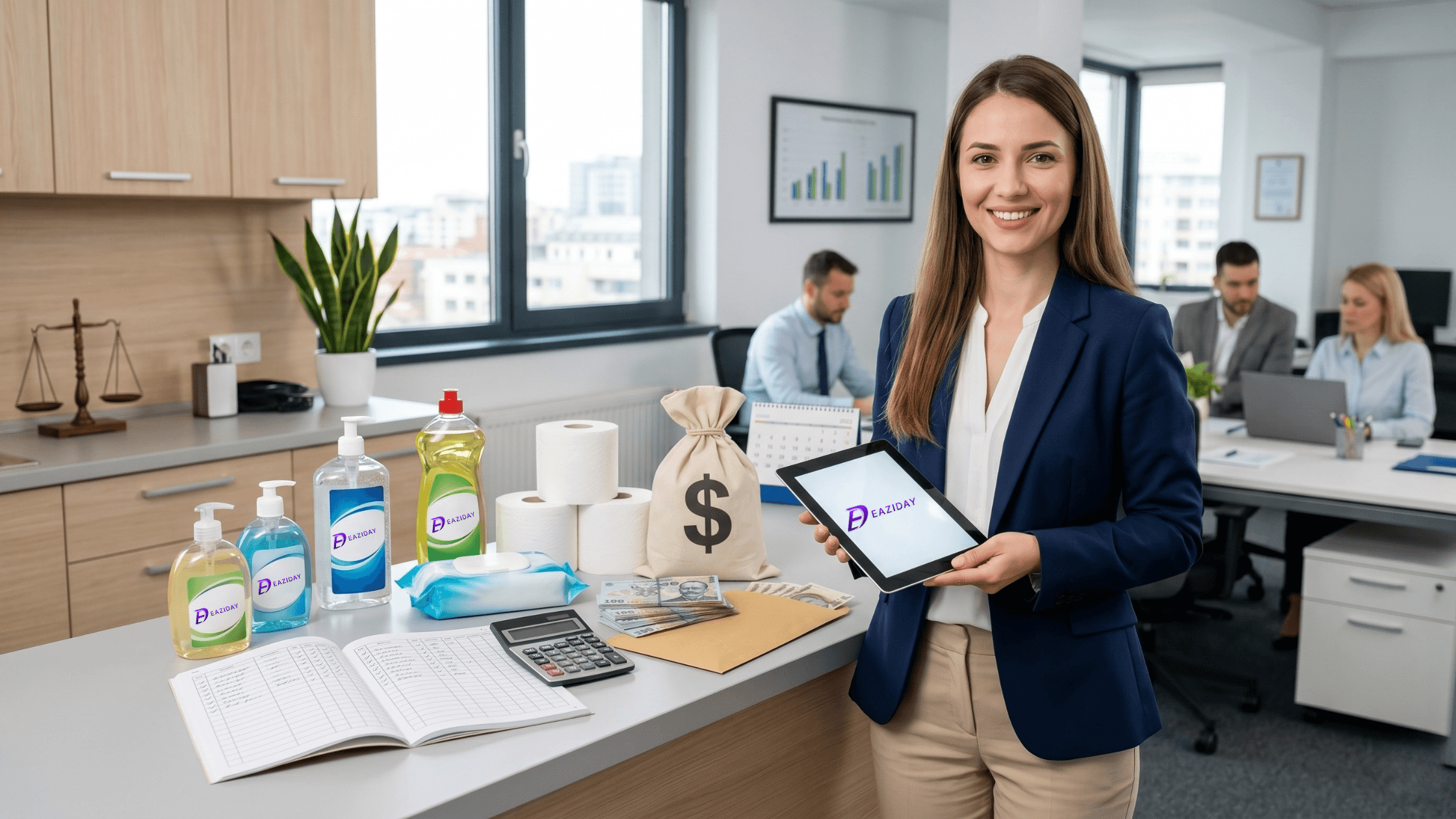
Cleaning and hygiene products used at your office are 100% deductible business expenses - but most companies either don't know this or manage it incorrectly. A complete guide with the legal basis, the full list of deductible products, real tax saving calculations, and what changed in 2026 with mandatory e-Invoicing.
There's a spending category that many Romanian businesses either pay from personal funds or incorrectly classify in their accounts, when they could be claiming it fully and legally: cleaning products, hygiene supplies and office consumables.
Not through deliberate ignorance. Simply because nobody has clearly told them that detergents, liquid soap, toilet paper and cleaning solutions used at the company's office or commercial space are fully deductible expenses - provided they're correctly documented.
If you're reading this and realising you've been missing this deduction, you're not alone. It's one of the most frequently overlooked categories in Romanian SME accounting.
The legal basis: what Romania's Fiscal Code says for 2026
Under Romania's Fiscal Code (Law 227/2015, as amended by GEO 8/2026), an expense is deductible if it cumulatively meets three conditions:
1. It is incurred for the purpose of carrying out the economic activity - it has a direct justification related to the company's object of activity
2. It is backed by supporting documents - an electronic fiscal invoice (e-Invoice), a receipt, or a contract
3. It is correctly registered in the accounts - in the journal register or fiscal records
Office consumables and cleaning and hygiene products fall under the category of "consumable materials", which are explicitly listed as fully deductible expenses under Article 25 of the Fiscal Code, alongside raw materials, stationery and other goods necessary to conduct the business activity.
Direct conclusion: If your company has a physical space in which employees, clients or partners operate — an office, shop, salon, practice, workshop, restaurant, coworking space, or anything else — the hygiene and cleaning products used in that space are 100% deductible.
Which products are fully deductible
Here is the complete list of cleaning and hygiene products you can expense through your company without restriction:
Workplace hygiene products
- Liquid soap and hand sanitiser (for dispensers in toilets and kitchen areas)
- Toilet paper and paper hand towels
- Wet wipes and paper napkins
- Hand sanitising gel
- Bin bags (all sizes)
Cleaning products
- Professional floor detergent
- Multi-surface cleaner
- Glass and mirror cleaner
- Surface disinfectant
- Anti-limescale solution (for toilets and bathrooms)
- Degreasing detergent (kitchen, equipment)
- Cloths, sponges, mops and cleaning accessories
Additional consumables
- Bags, wraps and packaging materials
- Room and toilet deodorisers
- Stationery and office supplies
- Printer consumables (toner, A4 paper)
Important note: The same type of product may be deductible for one company and non-deductible for another, depending on the business activity. An accounting firm that buys cleaning products for its offices - 100% deductible. The same firm buying cleaning products with no connection to its activity and using them at home — non-deductible. The difference is the destination and justification.
The e-Invoice requirement in 2026: what changes
From 1 January 2024, the e-Invoice (e-Factura) became mandatory for B2B transactions in Romania. From 1 January 2025, the obligation extended to B2C (business to consumer) transactions as well.
What this means practically for consumables deductibility:
A supplier invoice for consumables must be issued and transmitted through the RO e-Invoice system within 5 calendar days of the issue date. Without transmission through the Private Virtual Space (SPV), the invoice is not fiscally recognised and the expense cannot be deducted.
Practical implications:
- Your consumables suppliers must be registered and must issue e-Invoices
- Supermarket receipts are not sufficient as the sole supporting document for significant amounts
- If a supplier doesn't issue e-Invoices, you take the risk of being unable to deduct the expense
This is why partnering with a consumables supplier who automatically issues compliant e-Invoices is no longer an administrative detail — it's a condition for being able to benefit from deductibility.
The real tax saving calculation
Many entrepreneurs see deductibility as an abstract benefit. Here it is concretely, across three scenarios:
Scenario 1: Micro-enterprise, 5 employees, small office
Monthly consumables spend: RON 400
VAT included (19%): RON 63.87
Deductible VAT per month: RON 63.87
VAT recovered annually: RON 766
Profit tax saving (at the 1% turnover rate specific to micro-enterprises): the deducted sum reduces the tax base → saving of approximately RON 48/year
Total annual saving: ~RON 814 (VAT + tax) — from consumables you'd be buying anyway
Scenario 2: LLC paying corporate profit tax, 20 employees
Monthly hygiene consumables spend: RON 1,200
Deductible VAT per month: RON 191.60
VAT recovered annually: RON 2,299
Reduction of profit tax base (16% of deductible expenses): RON 2,304/year
Total annual saving: ~RON 4,603
Scenario 3: Restaurant or HoReCa space, 30 employees
Monthly professional consumables spend: RON 2,500
Deductible VAT per month: RON 399.16
VAT recovered annually: RON 4,790
Reduction of profit tax base: RON 4,800/year
Total annual saving: ~RON 9,590
Conclusion: The higher your consumables consumption, the more significant the tax saving. And this saving comes from expenditure you're making anyway — the only difference is whether you manage it correctly from a tax perspective or not.
The most common mistakes that cost at ANAF audits
1. Buying consumables with supermarket receipts only
A receipt is a valid supporting document for small and occasional amounts. If consumables restocking is done systematically at supermarkets without a company fiscal invoice, the expenses cannot be deducted — and if they're registered as deductible anyway, there's risk at audit.
2. Invoices from suppliers who don't issue e-Invoices
Since 2024, an invoice without transmission through e-Invoice is not fiscally recognised for deduction. Check whether your current suppliers are compliant.
3. Products bought "for the company" but used at home
ANAF can question consumable purchases if the volume is disproportionate to the number of employees or the size of the space. Document the destination of the purchases.
4. Incorrect accounting registration
Consumables are registered in account 3028 (other consumable materials) or 6022 (consumable materials expenses), not in inventory if consumed immediately. Your accountant needs to know this distinction.
5. Multiple suppliers, multiple invoices, difficult reconciliation
With 6–8 different consumable suppliers, monthly invoice reconciliation becomes complex and risky. A single supplier with one monthly invoice drastically reduces the risk of accounting error.
The Eaziday advantage for deductibility: everything solved from the start
There's an important practical difference between buying office consumables haphazardly (supermarket, multiple suppliers, receipts) and procuring them through an automated plan from a single supplier.
With Eaziday Business:
A single monthly invoice, e-Invoice compliant — issued and automatically transmitted to SPV, ready to register in the accounts without any action on your part. Your accountant receives one document per month, not ten.
Invoice with complete product breakdown — each consumable appears separately, with name, quantity and value. Documentation is clear and justifiable at any ANAF audit.
Supplier active in the e-Invoice system — no risk of working with a non-compliant supplier that compromises your deductibility.
Complete purchase history — from the Eaziday dashboard you have access to all invoices and deliveries, organised by month. At any audit, the information is one click away.
Plan calibrated to actual consumption — you don't over-buy, you don't justify volumes that are unjustifiable relative to your employee count.
How to set up your deductible consumables plan for your company
Step 1: Identify what consumables are needed in your workspace (type, estimated quantity, frequency).
Step 2: Contact Eaziday with your company profile — number of employees, type of activity, space. You receive a complete plan with products, quantities and prices within 24 hours.
Step 3: You activate the plan. Deliveries happen automatically at the established intervals. The compliant e-Invoice arrives monthly at your accountant.
Step 4: The accountant registers one invoice per month. VAT is deducted. The tax base is reduced. The tax saving happens automatically.
There is no step five. The system runs itself.
→ Set up your Eaziday Business plan — one invoice, guaranteed deductibility
Sources: Romania's Fiscal Code, Law 227/2015 as amended by GEO 8/2026; ANAF — e-Invoice Guide 2026; Romanian accounting and tax guidance sources 2026.