🎁 Save 100 Lei. ❤️ You choose the cause. We donate.Create a plan

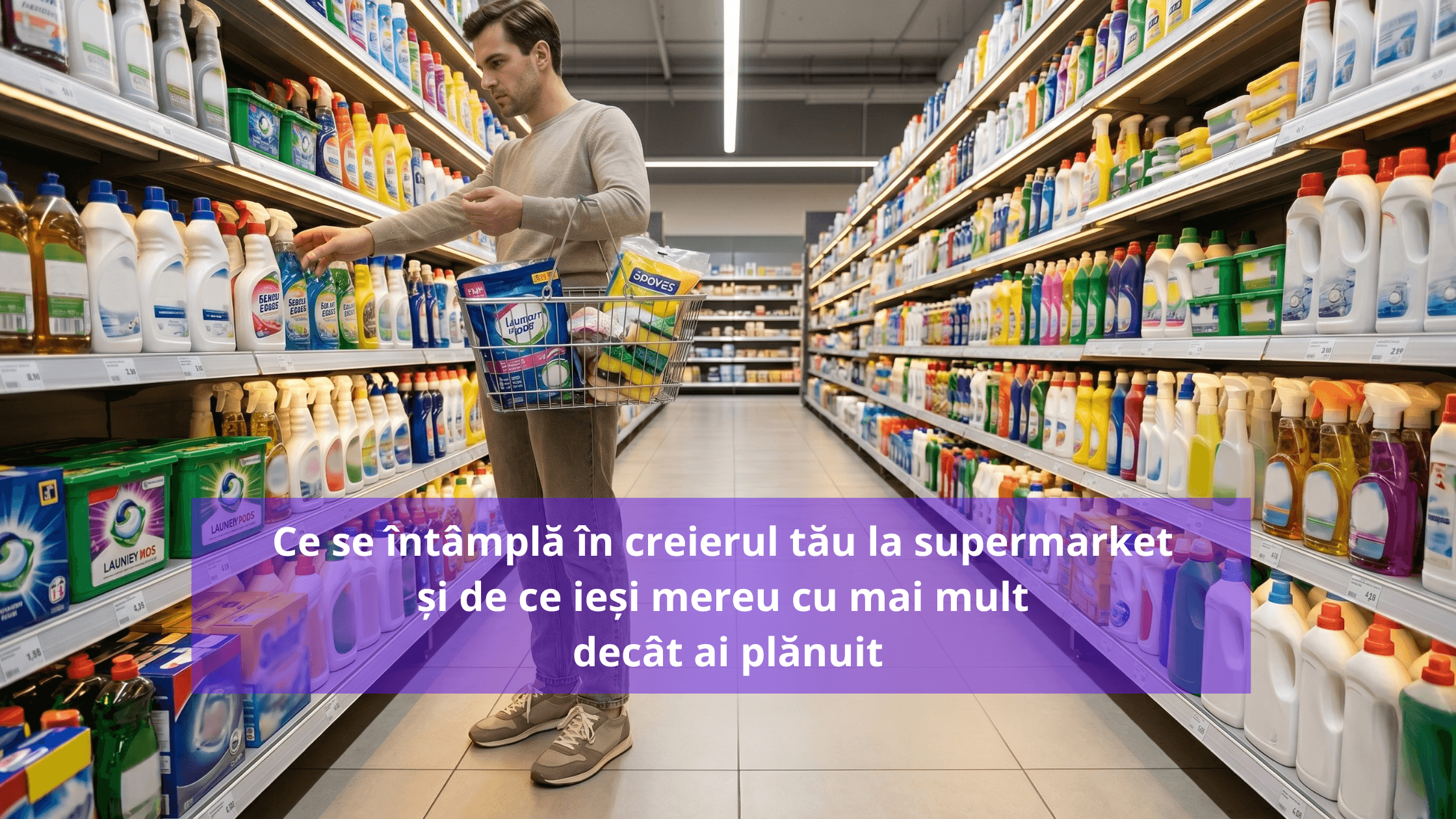
What happens in your brain at the supermarket and why you always leave with more than you planned
5 months ago
• ⏱️ 7 min read
You came in for dish soap. You left spending €18. It's not your fault - the supermarket was designed precisely for this. Discover the psychology behind store layouts, fake offers and why the essentials are always at the back.
One ordinary day in the week. You go to the supermarket to buy a dish soap.
You left with dish soap, two bottles of glass cleaner ("I needed to get some anyway"), a fabric softener (it was 2-for-1), and some biscuits that weren't on any list.
Planned spend: €3.
Actual spend: €18.
Has this happened to you? Of course it has. It happens to almost everyone.
The problem isn't that you're disorganised or lacking willpower. The problem is that the supermarket was designed - with meticulous precision and scientific rigour - to produce exactly this result.
The supermarket isn't a shop. It's a psychological experiment.
Clinical psychologist Dr. Dan Pallesen describes it directly: "From the moment you walk through those doors, you're being nudged. They're trying to get you to spend more money, they're trying to get you to buy certain things over others, and everything about that supermarket design is trying to influence your behaviour - subtly or subconsciously."
This isn't a conspiracy theory. It's an entire industry - retail psychology - with researchers, data and dedicated budgets focused exclusively on understanding and shaping purchasing behaviour.
Here's what happens, step by step, from the moment you walk through the door.
Step 1: The entrance - controlled disorientation
The first seconds inside a supermarket are deliberately calibrated.
The entrance is always spacious, bright and uncluttered. Retail psychologists call this the "decompression zone" — the area where your brain transitions from the pace of the outside world (traffic, rush, thoughts) to the pace of the store. You're vulnerable in these first few seconds: slightly disoriented, open to visual stimuli, guard down.
That's why the first products you see - usually flowers, fresh fruit or warm bread — aren't there by accident. They're there because they immediately trigger a sense of wellbeing, freshness and abundance. Your brain associates that feeling with the entire store.
You've already been sold to, psychologically speaking, before you've reached the first aisle.
Step 2: The essentials are always at the back
You came for milk, bread and detergent? All three are at the back of the store.
This is not a coincidence. It's not a space constraint either. It's a deliberate decision based on one simple principle: to reach what you need, you have to walk through the entire store.
And as you walk, you pass hundreds of products. The confectionery aisle. The "on offer" section (sometimes at prices that were artificially inflated beforehand). Complementary products placed strategically next to what you're looking for: next to toothpaste, dental floss; next to detergent, fabric softener; next to hand soap, washing-up sponges.
Optimising a supermarket's floor layout can increase revenue by up to 13.71% compared to traditional store designs — a figure that explains why no product placement decision is ever left to chance.
Step 3: Eye level is not an accident
There is a golden rule in merchandising: products at eye level sell best.
Retailers have known this for decades and pay for premium shelf positions. The products you didn't plan to buy — new launches, high-margin items, things "on offer" - are always at eye level.
Budget or generic products? Down at knee level. You have to make a physical effort to choose them - which significantly reduces their purchase rate.
Step 4: The offers that aren't really offers
70% of consumers have made an impulse purchase because something was "on offer" - according to Capital One Shopping data (2025).
The problem? Not all offers are genuine. The practice of raising the original price and presenting it as "reduced" is documented and widespread. Without a genuine reference point for the normal price, your brain simply cannot evaluate whether a deal is good or not.
And even when the offer is real, you buy more than you need. The "2-for-1" detergent is only a saving if you would have bought it anyway. If it triggered an unplanned purchase, you spent more, not less.
Step 5: The checkout - the final trap
You survived the cleaning products aisle. You resisted the sweets. You held firm against the on-offer fabric softener.
And now you're standing in the queue, with nothing to do, in front of a specially designed display of small, cheap, high-impulse products: batteries, chewing gum, chocolate, small household items.
Consumers are 39% more likely to buy impulsively when shopping for necessities — exactly the context you're in at the checkout, with essential products already in your basket.
How much does a "quick run to the shops" actually cost?
The average consumer makes approximately 9.75 impulse purchases per month, spending an average of $282 monthly on unplanned products — around $3,381 per year.
Even adjusting for purchasing power in Romania, the proportion holds: a significant share of the household shopping budget goes on unplanned items.
Impulse purchases account for up to 62% of supermarket sales revenue — and up to 80% in some product categories.
When you go to the shop for detergent and come back with a full basket, you haven't failed at willpower. You've been through a system optimised over decades to produce exactly that result.
Why cleaning products are the most vulnerable category
There's an irony in all of this: 42% of consumers are most prone to impulse purchases precisely when buying household products — the category that includes detergents, cleaning solutions and hygiene products.
Why? Because:
1. You buy them when you're in a rush. A "quick run" to the shop for detergent is by definition an unplanned visit. No time to compare, no preparation — more vulnerable to impulse.
2. The products are adjacent. Next to laundry detergent: fabric softener, wipes, whitener. Next to liquid soap: sponges and cloths. The system nudges you toward complementary purchases at every turn.
3. "On offer" works perfectly. Detergents, glass cleaners, liquid soap — all constantly appear in "2+1" or "30% off" offers. And since you'd buy them anyway, the offer always feels rational.
4. You don't know exactly what you have at home. You buy "just in case" because you're not sure how much you have left of each product. The result: a cupboard under the sink stuffed with half-empty or duplicate bottles.
The solution: take yourself out of the game
You can't beat a system designed by experts with decades of data on your behaviour. The only strategy that genuinely works isn't to resist better — it's to stop playing the game.
If cleaning and hygiene products come automatically to you — calibrated precisely to your actual consumption, at the right intervals — there's no reason for the "quick run to the shops." No exposure to inflated offers. No adjacent impulse buys. No budget overruns on this category.
Eaziday works on exactly this principle: you configure once what you need - detergent, liquid soap, anti-limescale solution, glass cleaner, floor cleaner - and everything arrives automatically at your door at the intervals you set.
Your budget on this category becomes fixed and predictable. Zero tempting "offers". Zero impulse buys. Zero overspending.
It's not about discipline or willpower. It's about systems. Conclusion: You're not the problem. The system is.
Next time you leave the supermarket with more than you planned, don't blame yourself. You've just been through a space designed by psychologists, designers and consumer behaviour specialists with one objective: to make you spend more.
The most effective defence isn't to go "better prepared". It's to eliminate the need to go at all.
Set up your Eaziday plan - automated restocking, predictable budget
*Sources:
Capital One Shopping - Impulse Buying Statistics 2025;
Webtribunal - 55+ Impulse Buying Statistics 2026;
Martech Zone - Grocery Store Floor Layouts 2025;
Arbitrage Trade - Psychology of Grocery Store Layouts 2025;
Dr. Dan Pallesen, Clinical Psychologist;
Invesp - State of Impulse Buying 2025.