🎁 Save 100 Lei. ❤️ You choose the cause. We donate.Create a plan

What Hygiene and Cleaning Products Does an Office Building Need (Complete Guide for Facility Managers 2026)
5 months ago
• ⏱️ 7 min read
An empty soap dispenser might not cost you cash upfront, but it ruins your building's quality standards and drains your team's time. Here is your complete 2026 guide: exactly what hygiene products an office building needs and how to turn reactive, complaint-driven procurement into a flawless automated system.
Related Base Packages
Monday morning, 9:05.
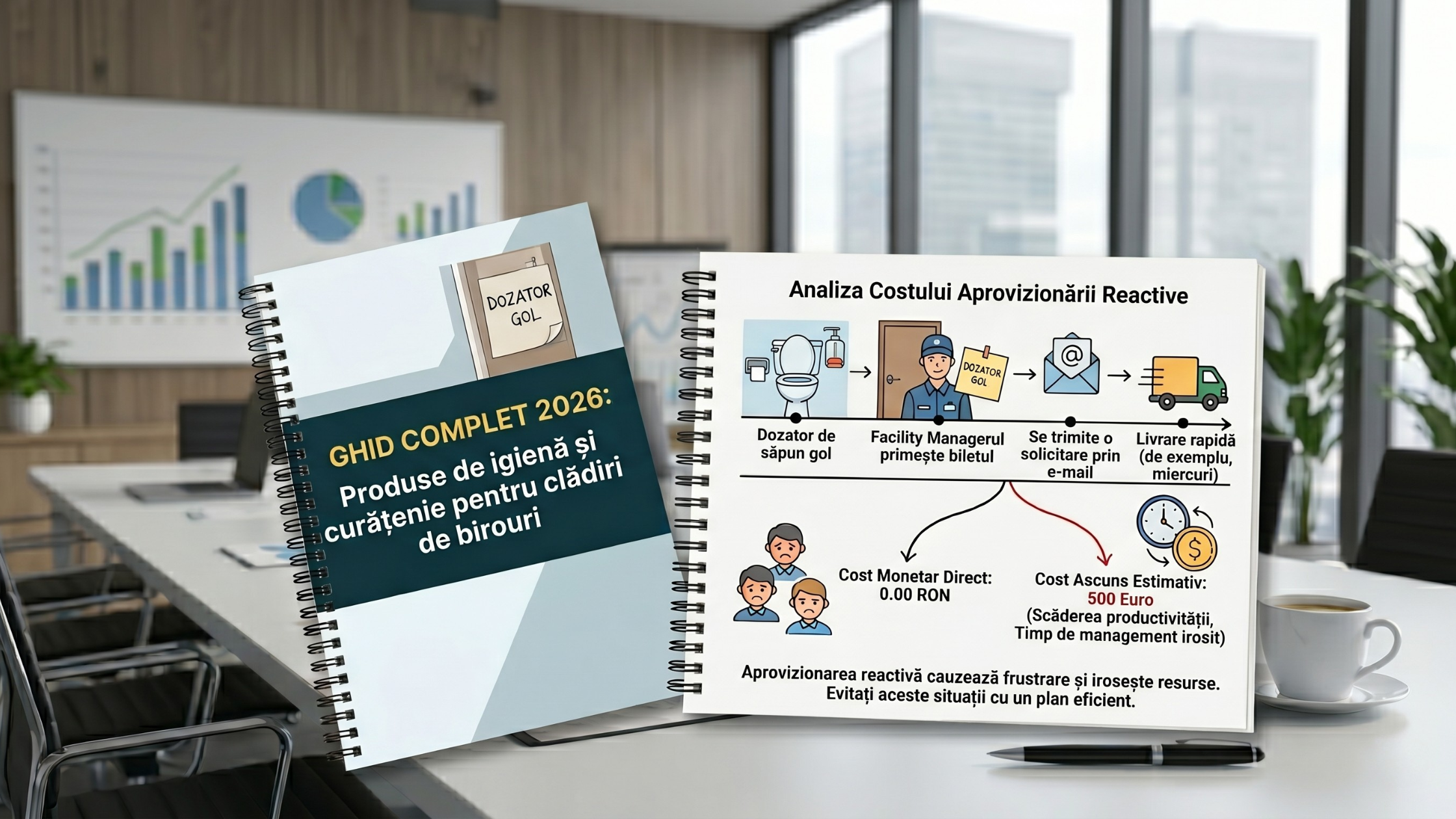
The first employee who goes to the third-floor toilet finds the soap dispenser empty. They leave a note on the door. The note reaches the facility manager at 9:45, after a meeting. The facility manager sends an email to the supplier at 10:00. The supplier confirms delivery for Wednesday.
The third-floor toilet runs without soap for two days. Fifty employees pass through. A few notice. Nobody is happy.
The cost of this incident: zero on any invoice. No money spent on the incident itself. But a few hundred euros in reduced employee satisfaction, a negative signal about the building's hygiene standards, and management time consumed on a problem that should never have existed.
This is the real cost of reactive hygiene product procurement in office buildings.
Why office buildings face different challenges from small offices
An office with 10 employees and one bathroom has a simple restocking problem: one person notices the soap has run out, orders more, problem solved.
An office building with 200 employees, 4 floors, 8 toilets, 4 shared kitchens, a reception area and 2 large conference rooms has a completely different level of complexity:
Volume: Daily consumption of toilet paper, liquid soap and paper towels is 10–20 times higher than a small office. A stockout doesn't affect 5 people - it affects 50 or 200.
Surface area: Each floor has its own needs. High-traffic floors (reception, ground floor) consume faster. Floors with fewer employees - more slowly. Uniform restocking across all floors is inefficient.
Zone diversity: The shared kitchen needs different products from the toilet. The conference room - different again. Reception - different. Technical spaces - different.
Fluctuating employee count: Physical presence varies. Monday and Tuesday - full office. Friday - 40% of people working remotely. Consumption fluctuates.
Visibility to tenants: The hygiene standard of an office building is a real competitive differentiator. Companies leasing space explicitly evaluate cleanliness and toilet facilities. A repeated hygiene incident can lead to contracts not being renewed.
What the data says about hygiene costs in office buildings
According to ISSA (International Sanitary Supply Association) and BLS (Bureau of Labor Statistics) 2026 data, cleaning and hygiene product costs for an office building represent 0.5–2% of total operating costs - a small category by percentage, but with disproportionate impact if managed poorly.
OfficeStoreApp (2026) estimates that businesses spend an average of $25–75 per employee per month on office consumables (including hygiene), with higher spend in high-traffic buildings and those with higher standards.
Companies that implement tracking systems and planned procurement reduce costs by 20–35% compared to reactive restocking - primarily by eliminating emergency orders and overstocking.
ISSA research shows that for a building with 25 employees, OSHA regulations mandate a minimum of 2 toilet cubicles. For 80 employees: minimum 4. For 150 employees: minimum 6. Each additional cubicle means proportionally more hygiene consumables.
Complete list by zone - what products, what quantities
🚻 Toilets (per toilet, per month)
Toilets are the zone with the highest consumption and highest visibility. A toilet with empty dispensers or finished toilet paper is the first negative signal.
Toilet paper
*Estimate per person per day:* 0.5–1 roll for standard office traffic
*Monthly calculation:* (Number of employees × 0.75 rolls/day × 22 working days) / number of toilets
*Example: 100 employees, 4 toilets:* ~412 rolls/month, ~103 rolls/toilet/month
*Recommended format:* Jumbo rolls (for industrial dispensers) — more economical than standard rolls
Liquid soap
*Estimate per person per day:* ~3ml per wash × 6–8 washes = ~18–24ml/day
*Monthly calculation:* 100 employees × 22ml/day × 22 days = ~48.4L/month
*Recommended format:* 5L canisters for refilling dispensers — more economical, less plastic
Paper hand towels
*Estimate per person per day:* 1 - 2 towels per wash × 6 washes = 6 - 12 towels/day
*Recommended format:* Wall dispenser rolls - more efficient than folded napkins
*Eco alternative:* Electric hand dryers reduce paper towel consumption by 80%
Hand sanitising gel
Post-pandemic, sanitiser gel in dispensers at toilet entrances is standard in any corporate building.
*Estimate: 1–2ml per use × 6 uses per person × 100 employees × 22 days = ~26.4L/month*
Toilet bowl cleaner
*Per cubicle:* 1–2 applications per day × 22 days = ~200ml/month/cubicle
*Total 4 cubicles:* ~800ml/month
Bathroom and tile cleaner
*Per toilet:* 500ml–1L/month (depending on cleaning frequency)
Toilet freshener
*Rim block:* 1 piece/2–4 weeks per cubicle
*Spray:* 1 bottle/month per toilet
Bin bags for waste bins
*Per bin:* 1–2 bags/day × 22 days = 22–44 bags/month
🍴 Shared kitchen (per kitchen, per month)
Washing-up liquid
*Estimate: 1L concentrate at 20ml/wash × 100 washes = 5L/month per kitchen*
*Recommended format: 5L concentrated canister — more economical than individual bottles*
Washing-up sponge / cloth
*Replace every 1–2 weeks: 2–4 per month per kitchen*
Surface degreaser spray
*For worktops, sink, microwave: 1 bottle 500ml/month*
Paper towels or napkins
*1–2 rolls/week per kitchen*
Liquid soap at the sink
*1 refill (500ml)/2–3 weeks*
Bin bags
*2–3 changes per day × 22 days = 44–66 bags/month per kitchen*
🏢 Reception and common areas
Surface disinfectant — for reception desks, touchscreens, lift buttons
*Daily use: 1 spray bottle 500ml/2–3 weeks*
Hand sanitising gel — dispenser at building entrance and reception
*1–2L/week depending on traffic*
Glass cleaner — for glass facades, mirrors, glass surfaces
*1 bottle 500ml/week for a reception with large glass surfaces*
Multi-surface cleaner — for furniture, shelves, reception appliances
*1 bottle 500ml/2–3 weeks*
📋 Conference rooms
Surface disinfectant — for tables, presentation areas, equipment
*1 bottle per room, renewed monthly*
Paper towels or napkins
*1–2 rolls/week per active room*
Waste bins with bags
*Daily change or after each meeting: 1 bag/use*
🧹 Technical and general cleaning areas
Professional floor detergent — for corridors, stairs, common spaces
*5L concentrate covers 500–1,000m² washed depending on concentration*
Floor disinfectant solution — especially for high-traffic areas
*1L/week per 200–300m² under normal conditions*
Mops and cloths - consumables replaced every 2–4 weeks
Quick estimation table: monthly consumption by employee count
| Product | 50 employees | 100 employees | 200 employees |
| Toilet paper (rolls) | 160–200 | 320–400 | 640–800 |
| Liquid soap (L) | 12–15 | 24–30 | 48–60 |
| Paper hand towels (rolls) | 40–60 | 80–120 | 160–240 |
| Hand sanitiser (L) | 6–8 | 12–16 | 24–32 |
| Washing-up liquid (L) | 3–5 | 6–10 | 12–20 |
| Bin bags (pcs) | 300–400 | 600–800 | 1,200–1,600 |
*Values are estimates for standard use. Buildings with high visitor traffic or intensive activity may exceed these figures by 30–50%.*
The most common facility manager mistakes
1. Reactive restocking (ordering when stock runs out)
The most common pattern and the most expensive. Generates emergencies, premium-priced rush orders, stockout periods and dissatisfaction in the building.
2. Uniform restocking across all floors
The floor with reception and the access area consumes 3–4 times more than a standard office floor. Uniform restocking means surplus on low-traffic floors and shortfall on high-traffic ones.
3. Multiple suppliers for the same category
Toilet paper from one supplier, soap from another, detergents from another. Administrative complexity, multiple invoices, inability to negotiate on consolidated volume.
4. Retail products instead of professional ones
Supermarket toilet paper rolls aren't compatible with industrial dispensers. Home liquid soap runs out 3 times faster in office dispensers compared to concentrated professional variants. The cost per use is much higher.
5. No consumption tracking
Without actual consumption data, any estimate is guesswork. Facility managers who don't track consumption formally (even a simple spreadsheet) will always order too much or too little.
The solution: planned, centralised, automated restocking
The right formula for an efficient office building:
- A single supplier for all hygiene and cleaning categories — eliminates administrative complexity and gains negotiating power on consolidated volume.
- Plan calibrated to employee count and zones — quantities are calculated on actual consumption, not estimates.
- Automatic deliveries at established intervals — stocks are replenished before they run out, not after. Zero "empty dispenser on Monday morning" incidents.
- A single monthly invoice — accounts processes one document, not ten.
- Consumption dashboard — at any time you know what's being spent on hygiene, by category, by month. You can justify any expenditure and optimise based on real data.
Eaziday Plan offers exactly this model for office buildings: you configure the plan once (30–45 minutes for a complex building), deliveries happen automatically, the invoice arrives monthly at accounts.
The facility manager handles other things. Toilets remain stocked. Employees notice no difference - which is exactly the point.
→ Set up your Eaziday office building plan - contact within 24h