🎁 Save 100 Lei. ❤️ You choose the cause. We donate.Create a plan

Why Do You Buy Too Many Cleaning Products? The Hidden Truth in Your Closet
Table of Contents
5 months ago
• ⏱️ 4 min read
Have too many cleaning supplies under your sink? Discover why you overstock and how Eaziday's automated supply plan helps you eliminate hidden costs.
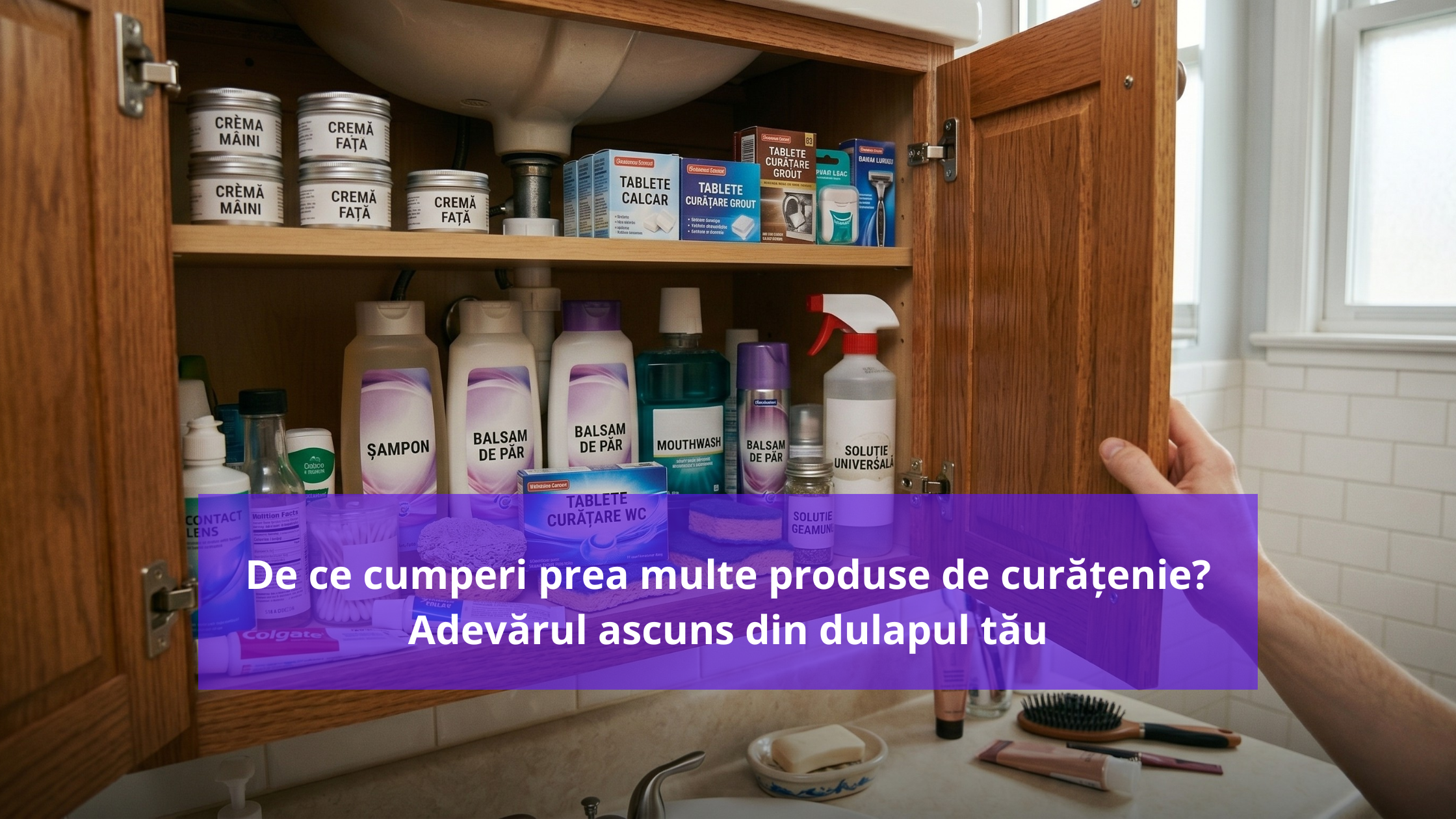
Open the cabinet under your sink. Or the one in the bathroom. When it comes to cleaning supplies organization, most of us hide a little chaos in there.
Take 30 seconds and look closely at what’s inside.
Chances are you’ll find: two or three bottles of glass cleaner (one empty, one half-full, one recently opened), dish soap from two different brands, a limescale remover you’re not sure is still good, and maybe a fabric softener you bought "as a backup" that’s been sitting there for three months.
This isn’t disorganization. This is your brain’s survival strategy. And it’s costing you more than you think.
The Psychology Behind Stockpiling: Why Do You Buy "Backup" Cleaning Supplies?
There is a clear psychological term for this: scarcity anxiety. It’s a deep evolutionary mechanism: the human brain is hardwired to avoid situations where you run out of essential resources.
The problem is that this mechanism was useful on the savanna, where running out of food could be fatal. Applied to dish soap in the modern day, it only produces overstuffed cabinets and blown budgets.
When you don’t have a predictable supply system - when you aren’t absolutely sure you’ll have what you need exactly when you need it - your brain compensates by overstocking. You buy extra "just to be safe." You grab two when you only need one.
The result? Useless stock, tied-up money, and, ironically, an underlying anxiety that you “don't exactly know what you have at home.”
The Hidden Costs: How Much Money Are You Wasting on Detergents and Sanitizers?
Products that degrade: Cleaning products have an expiration date. Liquid detergents lose their optimal efficiency 6 - 12 months after opening. Disinfectants degrade even faster. If you have 3 bottles of the same product, the oldest one is probably ineffective by the time you get to it.
Blocked storage space: An overcrowded cabinet is inefficient. You can't find what you're looking for, you forget about the products hiding in the back, and you end up buying something you already own.
Pointlessly tied-up cash: If you have 6 bottles worth around $5 each that you won't use in the coming months, you have $30 blocked. It’s not a huge sum, but it’s a recurring, silent loss.
Poor supermarket decisions: The biggest cost is indirect. Because you don't know exactly what you have at home, you buy "just as a precaution." Those impulsive micro-decisions add dollars to every receipt.
The Reserve Paradox: More Stock Means More Anxiety
Here is the truth no one tells you: overstocking doesn’t eliminate supply anxiety; it amplifies it.
When you have multiple half-empty products, your brain is simultaneously monitoring several inventories. Instead of clearly knowing whether you have detergent or not, you live in permanent uncertainty: "I think I still have some, but I'm not sure how much."
Psychologists call these "open loops" - unfinished tasks that consume mental resources in the background. A cabinet with ten half-empty bottles generates ten open loops. A cabinet with clear, predictable stock generates zero.
What a Proper Stock Actually Means
A healthy stock isn’t a large one; it is a precise and predictable one. You don't need backup reserves if you have the certainty that you will receive what you need before you run out.
Calculating your real consumption - example:
Dish soap: Do you go through a bottle every 10 - 14 days? You need exactly 2 bottles a month. Not 4 "for safety," not 6 "because they were on sale."
Glass cleaner: Do you use one bottle a month? You need 1 bottle a month.
The problem is that most people don't know their exact monthly quantities, and this lack of clarity feeds the chaos.
How to Eliminate Overstocking for Good And How Eaziday Helps
A well-organized cabinet doesn't mean a minimalist Instagram aesthetic; it means a space where you know exactly what you have, the bottles are full, and your stress is zero. This is achieved through automation.
Here are the steps to take back control:
Step 1: The Honest Audit (One time only). Open your cabinets. Throw away what's expired. Group the duplicates.
Step 2: Estimate your consumption. Think realistically about what you've used in the last 2 months.
Step 3: Set up your Eaziday plan. Configure your products and desired frequency once. Eaziday will automatically deliver your consumables, calibrated perfectly to your needs.
Step 4: Shift your mindset. Move from the "just in case" system to the "just in time" system.
An overstuffed under-sink cabinet is simply proof that you lack a predictable supply system. The solution isn't to become obsessively tidy, but to delegate the task entirely.
With Eaziday, cleaning and hygiene products arrive automatically at your door. Never zero stock. Never a surplus.
Configure your Eaziday plan and eliminate supply anxiety today