🎁 Save 100 Lei. ❤️ You choose the cause. We donate.Create a plan

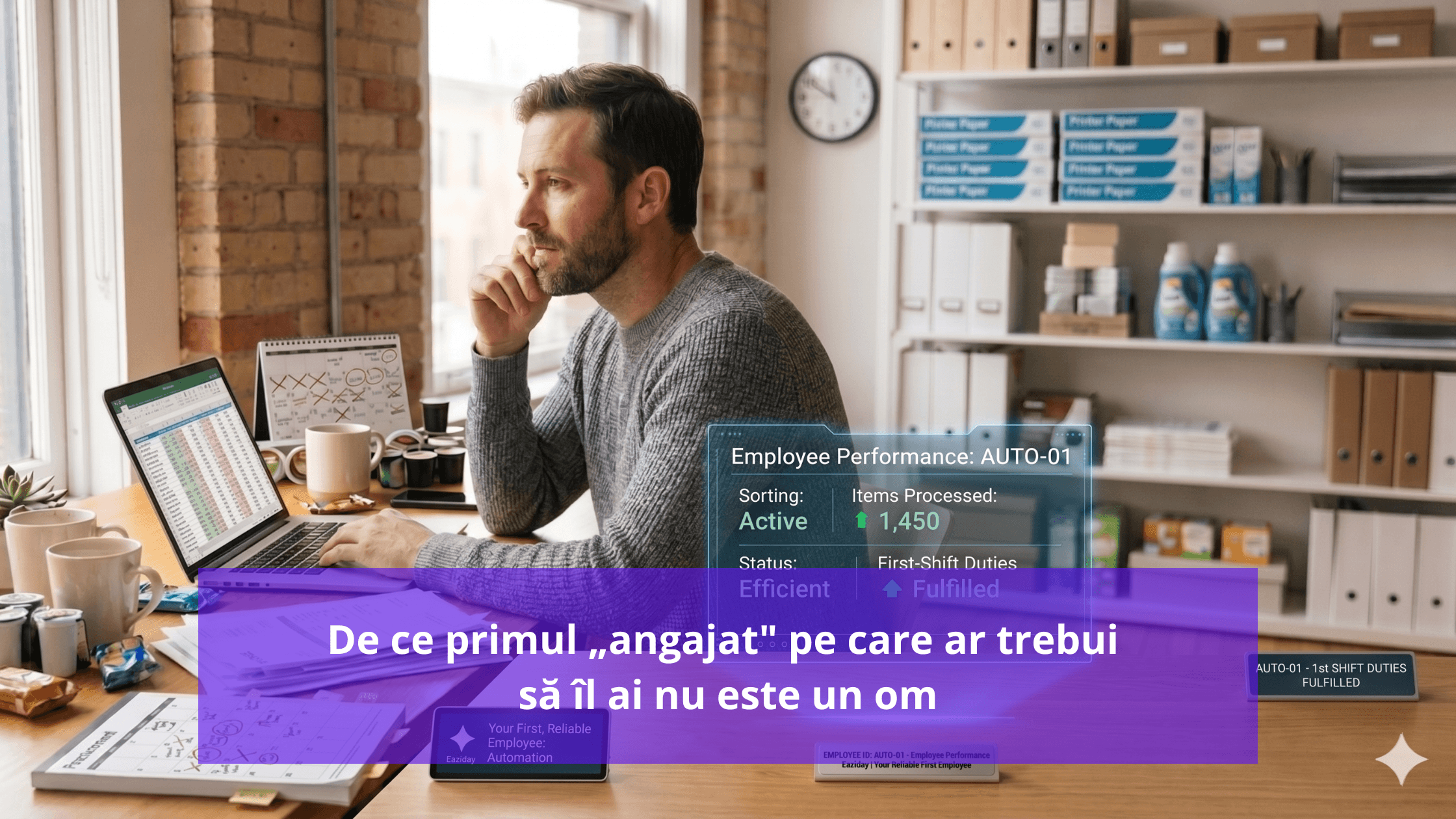
Why the first "employee" you should hire isn't a person
Table of Contents
Entrepreneurs lose two working days a week to repetitive tasks
What "the first employee" means in the age of automation
Why hygiene and cleaning supply procurement is the perfect category to automate
The time calculation: what manual management actually costs
The most important cost: opportunity cost
What changes when you automate procurement
How Eaziday works for businesses
5 months ago
• ⏱️ 6 min read
Entrepreneurs lose up to 16 hours a week on repetitive tasks that add no real value to their business. Hygiene consumables procurement is the first category you can fully automate - no complex software, no lengthy implementation, in 30 minutes.
You're a founder of a small or medium-sized business. Or the manager of a restaurant. Or the owner of a salon. Or the person running a team of 20 people who also handles everything operational.
And somewhere in this past week, you lost 40 minutes on something that shouldn't have been your problem: restocking the office or hygiene consumables.
Maybe you sent someone to the shop. Maybe you compared prices across three websites. Maybe you called a supplier because "they still haven't sent the invoice." Maybe you discovered the soap dispensers in the staff toilets were empty and someone had to sort it out.
40 minutes you could have invested in clients, strategy, your team, or your product.
That's the visible cost. The real cost is higher.
Entrepreneurs lose two working days a week to repetitive tasks
A widely cited study in the field shows that the average entrepreneur dedicates up to 16 hours per week to repetitive and administrative tasks - approximately two full working days not spent on clients or growing the business.
90% of employees say they have repetitive tasks that could be automated, according to McKinsey research. At a business level, automation can reduce costs by 10-50% by eliminating manual processing.
But here's what's specific to SMEs in Romania: 68% of European SMEs acknowledge that digitalisation is crucial for their future, but only 29% feel on track with implementation - according to a 2024 European Investment Bank study.
This means most small businesses know they should automate more. Few know where to start.
The answer is simpler than it sounds: start with what's easiest, most predictable, and least valuable for you to manage manually.
What "the first employee" means in the age of automation
There's a concept gaining traction among startup founders and SME managers: before you hire a second or third person, automate what you can.
This isn't about reducing jobs. It's about where human energy should go.
A full-time employee costs, including all employer contributions, €1,200-2,000+ per month in Romania in 2026. Their hours are valuable, limited, and should be invested in activities that require judgement, relationships and creativity.
Sending them to buy toilet paper is none of those things.
Automating administrative operations — including consumables procurement, hygiene and cleaning products - is exactly the type of high-frequency, predictable, repetitive task that requires no human judgement. And therefore shouldn't consume human time.
Why hygiene and cleaning supply procurement is the perfect category to automate
Not all business processes are equally easy to automate. Some require context, decision-making, relationships. Others are entirely mechanical.
Hygiene and cleaning product procurement ticks every box for easy automation:
It's predictable: Consumption of detergent, liquid soap, toilet paper and disinfectant varies slightly based on headcount and activity level, but can be estimated accurately after 2–3 months of data.
It's recurring: It repeats at regular intervals, every time with the same products and similar quantities.
It requires no human judgement: There's no complex decision involved in ordering 4 bottles of liquid soap per month versus 5. It's a simple numerical calibration.
It has clear consequences when neglected: Zero stock of disinfectant, toilet paper or detergent isn't a minor inconvenience - it means disrupted operations, dissatisfied clients or employees, and potential legal issues in regulated sectors.
The time calculation: what manual management actually costs
Let's run the numbers for an average business - say, an office of 25 people or a restaurant with 10 employees.
Traditional management (monthly):
| Activity | Estimated time |
| Checking current stock levels | 20 minutes |
| Identifying what's missing | 15 minutes |
| Price comparison / contacting suppliers | 30 minutes |
| Placing orders (multiple suppliers) | 20 minutes |
| Receiving and checking deliveries | 20 minutes |
| Processing multiple invoices | 30 minutes |
| Emergencies (shop runs, rush orders) | 60-90 minutes |
| TOTAL | ~3-4 hours/month |
At an hourly cost of a manager or office manager of approximately €6-8/hour: €18-32/month in human time on this category alone.
Add the emergency premium (25–40% more expensive than wholesale prices for urgent retail purchases) and the cost of processing multiple invoices - and you're easily looking at €60-100/month in hidden costs on a seemingly simple category.
Annually: €720-1,200 - from detergent and toilet paper.
The most important cost: opportunity cost
There's a cost the calculations above don't capture: what you could have done with those 3–4 hours a month.
For a founder or manager, 3 - 4 hours a month means:
- A strategic call with an important client
- A planning session with the team
- Reviewing and improving a key process
- Time for recruiting or giving feedback to employees
The opportunity cost of managerial time is, as a rule, far greater than the direct financial cost. Every hour a manager spends on consumables procurement is an hour lost from genuinely valuable activities.
47% of SMEs see a return on investment within 1- 3 years from automating processes - according to a 2025 study. The primary reason: small businesses automate simpler, high time-cost tasks first and recover the hours and costs quickly.
What changes when you automate procurement
Immediately (first month):
- Emergency shop trips eliminated
- Invoices to process reduced to one
- Clear visibility over hygiene spend for the first time
Medium term (3–6 months):
- Budget for this category becomes predictable and fixed
- Zero stockouts at critical moments
- The team is no longer distracted by consumable emergencies
Long term:
- An automation culture takes hold: if you can automate procurement, what else can you automate?
- More managerial time for genuinely valuable activities
- Competitive advantage over businesses still managing this manually
How Eaziday works for businesses
Eaziday Business is exactly this "first virtual employee" for hygiene and cleaning product procurement:
You configure once your company's plan - what products you need (professional detergents, liquid soap, surface disinfectant, anti-limescale solution, toilet paper, bin bags, whatever applies), in what quantities and at what frequency.
Eaziday delivers automatically at the established intervals - no manual orders, no stock checks, no emergencies.
You receive one single invoice - regardless of how many product categories are in the plan. Accounts processes one document, not ten.
You have full visibility through the dashboard - spend by category, delivery history, budget forecast.
You don't need a complex system. You need a decision.
Automation doesn't necessarily mean complex software, lengthy implementations or large investments.
Sometimes it simply means deciding that a category of repetitive tasks doesn't deserve your manual attention - and finding a system that handles it for you.
Hygiene and cleaning consumable procurement is one of the simplest and fastest "quick wins" in automation available to any business with a physical space.
It requires no special software. No training. No six-month implementation period.
It requires 30 minutes for initial setup - and from that point, it runs itself.
→ [Set up your Eaziday Business plan — 30 minutes, once only]
*Sources:
McKinsey & Company - Automation in Business 2024;
European Investment Bank SME Digitalisation Survey 2024;
Business Dasher - Business Automation Statistics 2025;
TechNuCom - SME Performance Productivity Automation 2025;
Rippling - Small Business Automation Research 2025.
Table of Contents
Entrepreneurs lose two working days a week to repetitive tasks
What "the first employee" means in the age of automation
Why hygiene and cleaning supply procurement is the perfect category to automate
The time calculation: what manual management actually costs
The most important cost: opportunity cost
What changes when you automate procurement
How Eaziday works for businesses